
Introduction
This is another entry in the minimum viable series at Circuspam, following the same idea we’ve used for the cheapest possible computer, the cheapest and longest-lasting bed, and our wider experiments with cheap housing, useful technology and off-grid living.
The question is always:
What do you actually need?
This time we’re applying it to food.
The goal isn’t the cheapest possible calories. It’s minimum viable cuisine: a small pantry, very little equipment, and a handful of ingredients that can become a huge number of genuinely good meals.
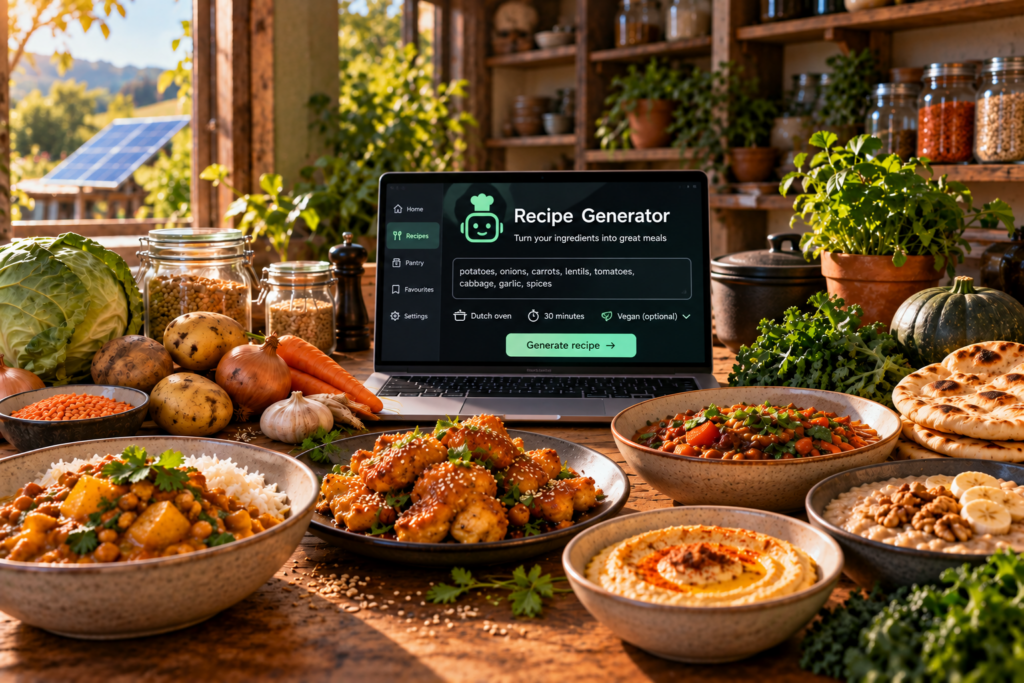
It also fits neatly into the off-grid side of the project. With solar power and a local AI model, we can even have a recipe generator help us work out what to cook with whatever we happen to have:
sun → electricity → computer → recipe generator → food
We’ll start with cheap convenience food, then build a tiny but capable kitchen, and finally look at long-term food storage and growing.
The aim is simple: find out how little you actually need to eat really well.
The idea: don’t optimise for miserable food
There is a particular kind of “cheap food” advice that seems to believe the final objective is to produce the lowest possible number on a supermarket receipt.
Buy the cheapest calories.
Eat the same thing every day.
Remove anything interesting.
Congratulations: you have achieved an extremely cheap diet that you will probably stop eating.
That isn’t what I mean by minimum viable cuisine.
The aim here is different.
I want the smallest practical food system that still gives you:
- decent nutrition;
- food that actually tastes good;
- very little equipment;
- very little refrigeration dependency;
- ingredients that can be reused across hundreds of dishes;
- food that works when you are tired;
- food that works when electricity is limited;
- and a path from “I need dinner tonight” towards genuine long-term food security.
This is the food equivalent of the other “cheapest possible” projects: find the bottom of the market, work out what is genuinely necessary, remove the expensive complexity, and then build upwards from there.
It isn’t about glorifying deprivation.
It is about discovering how little you actually need.
And, rather importantly, the recipes in this system are really good.
Some of them look almost absurdly simple on paper. Potatoes, an onion, some dried mushrooms, a bit of tomato, vinegar and a handful of nuts should not sound like a recipe for something approaching restaurant food.
And yet it works.
That is the interesting bit.
Part One: The Cheapest Possible Convenience Food
There are days when the problem isn’t cooking.
The problem is that you absolutely do not have time to cook.
You have work, travel, studying, children, a broken kitchen, exhaustion, or some other chaos happening simultaneously.
On those days, the minimum viable kitchen starts with something much more rudimentary:
bread + things you can put on bread.
The supermarket-in-a-delivery-app trick
A food-delivery service such as Uber Eats or Just Eat can be useful here, but the trick is not to order somebody else’s finished sandwich.
Use the service as a tiny grocery delivery system where that is available and economical.
You want ingredients that can be eaten immediately without:
- chopping boards;
- pans;
- plates;
- cooking;
- washing up;
- or particularly heroic levels of motivation.
A basic convenience order could contain:
| Role | Cheap options |
|---|---|
| Main carbohydrate | Bread, wraps, pitta, crackers |
| Protein/fat | Peanut butter, hummus, nuts, seeds, vegan cheese |
| Freshness | Tomatoes, apples, cucumber, salad leaves |
| Sweet | Jam, golden syrup, fruit |
| Savoury | Pickles, chutney, mustard, soy-based spreads |
| Emergency backup | Oatcakes, biscuits, ambient plant milk, tins |
| Drinks | Tea, coffee, water |
| Flavour | Salt, pepper, chilli sauce, vinegar |
The point is not to buy all of these.
The point is that each ingredient should perform several jobs.
A jar of jam is not just jam.
It is toast topping, porridge topping, baking ingredient and emergency sugar.
Peanut butter is not just a sandwich filling.
It is sandwich filling, porridge topping, satay sauce base, curry thickener and a cheap source of energy and protein.
Tomatoes are not just salad.
They can go into sandwiches, stews, pasta, curries, toast and sauces.
This is the basic rule of minimum viable cuisine:
Buy ingredients, not single-purpose foods.
The cool-box sandwich system
There is one important distinction between this first section and the rest of the article.
Here we are deliberately using chilled storage.
You can assemble a small grocery order containing sandwich ingredients, put the chilled items straight into a good cool bag or cool box with ice packs, and use them over the following days.
The blanket is useful because it provides another layer of insulation.
It is not, however, a magical refrigerator.
The safe version of this setup is:
cold ingredients → properly chilled cool bag → plenty of ice/ice packs → insulation around the cooler → temperature checked periodically.
For chilled foods, the goal is to keep them below 8°C. If the food warms above that, don’t assume an insulating blanket has somehow reset the clock. The Food Standards Agency specifically advises keeping chilled food below 8°C and minimising the time chilled foods spend outside proper refrigeration.
This also produces a useful ordering trick.
Put the refrigerated food at the front of the order
Buy the ingredients that genuinely need chilling for the first part of the plan.
Then buy ambient ingredients for the later days.
For example:
Day 1–2
- vegan cheese;
- tomatoes;
- hummus;
- fresh salad;
- bread.
Later days
- peanut butter;
- jam;
- crackers;
- oats;
- apples;
- dried fruit;
- tinned foods;
- shelf-stable sauces.
Now the cool box is doing something useful rather than being asked to refrigerate your entire pantry.
The three-minute sandwich kitchen
The minimum viable sandwich is almost embarrassingly simple.
Bread.
Something fatty.
Something savoury.
Something acidic or fresh.
Something sweet if desired.
That gives you combinations such as:
peanut butter + jam
vegan cheese + tomato + black pepper
peanut butter + apple
hummus + tomato + chilli
vegan cheese + pickle + mustard
jam + golden syrup
tahini + tomato + salt
The more interesting observation is that you can turn the same ingredients into completely different cuisines once you have access to a stove.
That is why the rest of this article matters.
The sandwich system is the emergency minimum.
The pantry system is where the fun begins.
Part Two: The Cheapest Possible Cuisine
This is the main event.
The idea is to build a kitchen where a surprisingly small collection of ingredients can produce an enormous range of meals.
The kitchen does not need to look like a professional kitchen.
You do not need seven appliances.
You don’t need a collection of specialist gadgets.
You especially don’t need a different appliance for every ingredient.
The minimum viable kitchen
The core equipment is surprisingly small.
1. Dutch oven
This is the workhorse.
A decent Dutch oven can act as:
- a large saucepan;
- a stew pot;
- a frying vessel;
- a casserole;
- a bread oven;
- a roasting pot;
- a baking chamber;
- and, with suitable fuel and care, part of an outdoor/off-grid cooking system.
It is one of those pieces of equipment where buying one decent object is cheaper than buying six mediocre appliances.
2. Slow cooker
The slow cooker does something completely different.
It trades time for low, steady electricity.
That makes it particularly interesting in an off-grid system with a battery, solar panels and a suitable inverter.
You should still check the actual power rating of your slow cooker and the capacity of your solar/battery setup. “Runs on solar” does not mean “uses no electricity”.
The attraction is that a slow cooker can take a relatively low amount of continuous electrical power and turn inexpensive ingredients into something that tastes like you spent all day cooking.
3. Knife and chopping board
That’s nearly the entire list.
Add a mixing bowl, spoon, measuring jug and a few basic utensils.
A kettle can be helpful, but it is optional.
You don’t need:
- an air fryer;
- a rice cooker;
- a blender;
- a food processor;
- a bread machine;
- a soup maker;
- a deep fryer;
- or a kitchen appliance whose primary function is taking up cupboard space.
The minimum viable principle is:
One tool should do several jobs.
The pantry that unlocks hundreds of meals
The ingredient list looks almost boring.
That’s the trick.
Core carbohydrates
- Potatoes
- Pasta
- Rice
- Bread
- Porridge oats
- Flour
Vegetables
- Onions
- Carrots
- Tinned tomatoes
- Tomato purée
- Tinned mixed vegetables
- Dried mushrooms
- Sundried tomatoes
- Chilli
- Sweetcorn
Protein and texture
- Lentils
- Chickpeas
- Peanuts
- Cashews
- Pine nuts when affordable
- Tahini
- Peanut butter
- Beans
- Peas
Flavour
- Soy sauce
- Miso
- Apple cider vinegar
- Salt
- Black pepper
- Curry powder
- Paprika
- Mixed herbs
- Thyme
- Rosemary
- Chilli
- Garlic granules
Sweet and sour ingredients
- Apples
- Dried apricots
- Raisins
- Tinned pineapple
- Tinned pears
- Apple sauce
- Jam
- Golden syrup
- Sugar
Fat
- Olive oil
- Rapeseed or sunflower oil
- A vegan buttery spread where storage conditions allow
And that is basically it.
It does not look like a particularly impressive supermarket haul.
But watch what happens when you combine the ingredients.
The 1,000-meal pantry
Think of the pantry as a set of Lego bricks.
There is a base.
There is a protein.
There is a flavour direction.
There is a texture.
There is an acid.
There is a fat.
There is sometimes a sweet element.
The exact number doesn’t matter. The point is that a surprisingly small pantry can produce an enormous number of combinations.
Take potatoes.
Potatoes + tomato + lentils + paprika
Tomato-lentil potato stew.
Potatoes + miso + peanuts + chilli
Miso peanut potato curry.
Potatoes + mushroom + thyme + vinegar
Mushroom potato stew.
Potatoes + apple + pineapple + curry powder
Sweet-and-spicy potato fruit curry.
Potatoes + carrots + pears + herbs + dumplings
Apple-carrot stew.
Potatoes + oil + chilli + salt
Chilli potatoes.
Now replace potatoes with pasta.
Then rice.
Then bread.
Then flour dumplings.
Suddenly the cupboard isn’t boring any more.
It is an ingredient generator.
Using AI as the recipe engine
This is the part that makes the tiny pantry feel much larger.
We can ask an AI model to work under constraints.
For example:
I have potatoes, onions, carrots, chopped tomatoes, dried mushrooms, lentils, chickpeas, pasta, rice, flour, apples, dried apricots, peanuts, tahini, soy sauce, vinegar, miso, tomato purée, chilli, oil and mixed herbs.
Give me ten different vegan meals using these ingredients.
Prefer one-pot meals.
Minimise washing-up.
Minimise fuel consumption.
Use a Dutch oven or slow cooker.
Make the dishes genuinely different rather than just changing the name.
This is where local AI gets particularly fun.
A model such as Gemma can potentially run locally on suitable hardware without requiring a constant internet connection.
So your recipe system can become a little offline tool.
You give it:
what ingredients you have
what cooking equipment you have
how much fuel or electricity you want to use
how much time you have
and it can help you work out the process without you having to know every quirk and requirement of every combination beforehand.
I think that’s worth being proud of. This is what makes this diet viable.
sun → electricity → computer → recipe generator → food
Don’t forget the humble flour
Flour is one of the highest-leverage ingredients in the whole system.
It makes bread.
It makes pancakes.
It makes flatbreads.
It makes dumplings.
It thickens sauces.
It makes batter.
It makes pastry.
And it can transform a thin stew into something that feels like a complete meal.
This is especially useful when you are trying to reduce cooking costs.
A pot of vegetables can feel like “vegetables”.
A pot of vegetables with homemade dumplings on top suddenly becomes dinner.
Recipe 1: Spiced Potato and Fruit Curry
This is one of the recipes that proves why a minimum viable pantry works.
It sounds strange.
It tastes surprisingly deliberate.
The combination of fruit, tomato, chilli, curry spice and vinegar creates something much more interesting than the ingredient list suggests.
Ingredients
- 2 medium potatoes, peeled and diced small
- ½ medium onion, finely sliced
- ½ medium apple, peeled and diced
- 3–4 tablespoons tinned pineapple chunks
- 1–2 tablespoons pineapple juice to begin with
- 3 sundried tomatoes, finely chopped
- Fresh chilli, to taste
- 1 teaspoon olive oil
- 15–20g cashews
- ½ teaspoon salt
- 1–1½ teaspoons curry powder or spice blend
- 1 generous teaspoon tomato purée
- Small splash of apple cider vinegar
Dutch oven method
Put the potatoes, onion, apple, pineapple, sundried tomatoes and chilli into the Dutch oven.
Add the oil, salt, curry powder and tomato purée.
Start with a small amount of pineapple juice rather than flooding the pot.
Cover and cook gently for around 25–35 minutes, stirring occasionally, until the potatoes are tender.
Finish with a little apple cider vinegar.
Add the cashews just before serving.
You might need to work out how much water or fruit juice is ideal in your own setup. Different pots, lids, burner strengths and ingredient quantities behave differently.
That’s not a failure of the recipe.
It’s part of learning your kitchen.
Slow cooker method
Add everything except the cashews and most of the vinegar.
Cook on:
HIGH: about 3–4 hours
or
LOW: about 5–6 hours
Add the vinegar towards the end, taste and adjust.
Finish with cashews.
Recipe 2: Gourmet Mushroom Potato Stew
This one is perhaps the best demonstration of how far a few pantry ingredients can go.
Potatoes.
Onions.
Dried mushrooms.
Tomatoes.
Nuts.
A little acidity.
That’s about it.
Ingredients
- 2 medium potatoes, peeled and diced small
- ½ medium onion, finely sliced
- 1 small handful dried mushrooms
- 4 tablespoons mushroom soaking water
- 3 sundried tomatoes, finely chopped
- 1 teaspoon olive oil or suitable artichoke oil
- 1 generous teaspoon tomato purée
- Small splash of apple cider vinegar
- 15–20g cashews
- ½ teaspoon salt
- 1–1½ teaspoons spice blend
- Black pepper
- Paprika
- Dried herbs
- Optional: 1–2 teaspoons oat milk powder
Dutch oven method
Soak the dried mushrooms in boiling water for about 10 minutes.
Chop them.
Keep some of the soaking water.
Mix the mushroom water with the oat milk powder, tomato purée and apple cider vinegar.
Put everything else apart from the cashews into the Dutch oven.
Add the mushroom mixture.
Cover and simmer gently for around 30–40 minutes, until the potatoes are tender.
Stir occasionally.
Add the cashews and cook for another few minutes.
Slow cooker method
Put the potatoes, onion, mushrooms and sundried tomatoes into the slow cooker.
Add the oil, seasoning and mushroom liquid.
Cook on:
LOW: 5–6 hours
or
HIGH: about 3–4 hours
Add the cashews around 15 minutes before eating.
A little extra thyme at the end is excellent.
This is also very good served with crispy chilli potatoes.
Recipe 3: Apple, Carrot and Pear Stew with Dumplings
This is another strange-sounding meal that becomes extremely comforting once it is cooked.
Fruit does not have to mean dessert.
Apple and pear can be used exactly like a sweet element in a savoury sauce.
Stew ingredients
- 3–4 medium carrots, sliced into thick coins
- ½ medium onion, finely sliced
- 2 medium potatoes, diced
- 3–4 tablespoons tinned pears
- 2 tablespoons pear juice
- 2 generous teaspoons apple sauce
- Small splash of apple cider vinegar
- 1 teaspoon olive oil or vegan buttery spread
- ½ teaspoon salt
- 1 teaspoon mixed herbs
- Thyme
- Rosemary
- 15–20g cashews
Dumplings
- 8 level tablespoons plain flour, about 60–65g
- 1½ tablespoons vegan buttery spread, about 15g
- 2–3 tablespoons cold water
Slow cooker method
Mix the pear juice, apple sauce and vinegar.
Put the carrots, onion, potatoes and pears into the slow cooker.
Add the liquid, oil or spread, salt and herbs.
Cook on:
HIGH: 3–4 hours
or
LOW: 6–7 hours
Make the dumplings by rubbing the flour and vegan spread together until crumbly, then adding water until a soft dough forms.
Divide into four balls.
Place them on top of the stew around 30–45 minutes before serving.
Add the cashews.
Replace the lid and leave it alone so the dumplings can steam properly.
If the stew is thinner than you want, add a little flour mixed with cold water before adding the dumplings.
Otherwise, just enjoy it as a lighter fruit-and-vegetable stew.
Dutch oven method
Cook the stew ingredients, covered, over a gentle simmer for around 30–40 minutes, until the vegetables are tender.
Add the dumplings to the surface, cover tightly and cook for another 15–20 minutes until fluffy.
Do not keep removing the lid.
Recipe 4: Miso and Potato Curry
Miso is an extremely useful pantry ingredient because a small amount gives you a huge amount of savoury flavour.
Ingredients
- 1 tin potatoes, drained and chopped
- ½ fresh potato, diced very small
- 1 medium onion, finely sliced
- 1½–2 medium apples, peeled and diced
- 2 miso sachets
- 4 tablespoons warm water
- 1 generous tablespoon Tartex or similar savoury spread
- 2 teaspoons olive oil
- 2 small handfuls cashews or peanuts
- ½ teaspoon salt
- 1 teaspoon spice blend
- Ginger powder, mild curry powder, chilli or black pepper
- Optional: sweetcorn
- Optional: raisins
Dutch oven method
Put the onion, oil and fresh potato into the Dutch oven.
Cook gently for around 5–10 minutes.
Add the tinned potatoes, apple, Tartex, seasoning and most of the nuts.
Add a small splash of water if needed.
Cook covered for another 15–20 minutes, stirring occasionally.
Mix the miso with warm water and add it towards the end.
Taste carefully before adding more salt because miso and soy-based ingredients can already be salty.
Slow cooker method
Add the potatoes, onion, apple, Tartex, oil, seasoning and nuts.
Cook on:
HIGH: 3–4 hours
or
LOW: 5–6 hours
Add the diluted miso during the final 15–30 minutes if you want more of its fresh savoury character.
Sweetcorn and raisins are surprisingly good here.
And yes, this can become extremely spicy.
Recipe 5: Hearty Tomato and Lentil Pasta
This is the meal that looks like nothing and turns out to be useful about six times a month.
Ingredients
- 150–180g pasta
- 60–70g red lentils
- ½ onion, finely chopped
- About 200g chopped tomatoes
- 1 generous tablespoon tomato purée
- 1 tablespoon sundried tomatoes, chopped
- 400–550ml water
- 1 teaspoon oil
- 1 tablespoon soy sauce
- ½ teaspoon salt
- Black pepper
- Paprika or chilli
- ½ teaspoon dried oregano or mixed herbs
- Small splash apple cider vinegar
- Optional peas or sweetcorn
- Optional tahini or peanuts
Dutch oven method
Cook the onion in the oil for 5–10 minutes.
Add the tomato purée.
Add the tomatoes, lentils, herbs, soy sauce and around 400ml water.
Bring to a simmer.
Add the pasta.
Cook for around 10–15 minutes, stirring regularly and adding more water when needed.
The lentils soften into the sauce while the pasta cooks.
Finish with a small splash of vinegar.
Tahini makes it creamy.
Peanuts add crunch.
Slow cooker method
This one is possible, but it is much less forgiving because pasta can overcook.
Add the onion, tomatoes, tomato purée, lentils, seasoning and water.
Cook on HIGH for around 2 hours, then add the pasta for the final 20–40 minutes, depending on the pasta.
Add more water as necessary.
For minimum fuel and maximum predictability, however, I prefer the Dutch oven version.
Recipe 6: Sticky “Takeaway-Style” Sesame & Tahini Battered Apple Chunks
Now we get to the completely unnecessary recipe.
Except it isn’t unnecessary.
A minimum viable diet needs food that feels like takeaway food.
And this one is not merely takeaway-inspired.
When prepared properly, the batter is uncannily close to the texture of a Cantonese-style takeaway dish.
The crisp shell, the sticky sweet-sour sauce, the soy and vinegar, and the soft fruit inside make this work as a direct substitute for the kind of sweet battered takeaway dish you might otherwise order.
Do not underestimate this recipe.
It is extremely good.
Ingredients
Apple
- 1½ large apples, peeled, cored and cut into small bite-sized cubes
- ½ apple, finely grated for thickening
- 1 tablespoon plain flour for dredging
Crispy tahini batter
- ½ cup plain flour
- 1 tablespoon tahini
- 1 small dollop vegan buttery spread
- 1½ teaspoons sugar
- 1 level teaspoon garlic granules
- ½ teaspoon salt
- 5–6 tablespoons water
Frying
- About ½ inch sunflower oil in the Dutch oven
Lemon-style sauce
- 1 apple, finely grated
- 2 tablespoons tomato purée
- 4 tablespoons dark soy sauce
- 4 tablespoons apple cider vinegar
- 3 tablespoons sugar
- 240ml boiling water
Method
Whisk the sauce ingredients together.
Dry the apple pieces thoroughly.
Toss them through the flour until completely coated.
Mix the batter ingredients together, adding the water gradually until it becomes a thick paste.
Add the apples and make sure the batter completely coats them.
Heat the oil in the Dutch oven carefully.
Test it with a tiny amount of batter.
It should sizzle immediately.
Fry the apple pieces in small batches for around 2–3 minutes per side, until deeply golden and crisp.
Do not overcrowd the pot.
Remove the apples and drain them.
Carefully deal with the hot oil according to your equipment and setup.
Add the sauce to the Dutch oven.
Simmer for around 3–4 minutes, stirring, until the grated apple breaks down and the sauce becomes glossy and thick.
Turn off the heat.
Toss the crispy apples through the sauce.
Serve immediately.
This is exactly the sort of recipe that proves minimum viable cuisine does not have to mean miserable cuisine.
Recipe 7: Dutch Oven Bread
Bread is almost absurdly useful because flour can also become dumplings.
So you have two choices:
make bread like this
or
turn the same flour into dumplings and put them on top of a stew.
Same pantry.
Different dinner.
Ingredients
- 500g plain or strong white bread flour
- 7g instant dried yeast
- 10g salt
- 1 teaspoon sugar
- 350ml warm water
- 1 tablespoon oil
Optional:
- dried herbs;
- seeds;
- black pepper;
- olives;
- sundried tomatoes.
Method
Mix the flour, yeast, sugar and salt.
Add the water gradually.
Add the oil.
Mix into a dough.
Knead for around 5–10 minutes, or use repeated stretches and folds if you want a less hands-on method.
Cover and allow to rise until noticeably expanded.
Shape into a round.
Preheat the Dutch oven.
Place the dough inside carefully.
Cover with the lid.
Bake at around 220–230°C for 30 minutes.
Remove the lid and continue for another 10–15 minutes, until deeply browned.
Let it cool before slicing.
The same basic flour can now also become:
dumplings
flatbreads
pancakes
batter
thickener
pastry
That is why flour deserves its place in the minimum viable pantry.
Bonus: Hummace — the very cheap chickpea spread
I’m calling this hummace because it is basically hummus stripped down to the minimum.
No blender required.
Ingredients
- 1 tin chickpeas, drained
- 1 tablespoon tahini
- 1 teaspoon apple cider vinegar or lemon juice
- 1 teaspoon oil
- Pinch of salt
- A little water
- Optional garlic
- Optional black pepper
- Optional chilli
Method
Mash the chickpeas thoroughly with a fork.
Add the tahini, vinegar, oil and salt.
Add water a teaspoon at a time until it becomes the consistency you like.
That is it.
You don’t need to make restaurant-smooth hummus.
A rough, creamy chickpea spread is actually perfect for:
- sandwiches;
- toast;
- wraps;
- potatoes;
- vegetables;
- crackers.
And because there is no blender involved, you have also reduced electricity usage and washing-up.
Porridge can become oat milk in about 30 seconds
This is another useful little kitchen trick.
Make a very thin porridge from oats and water.
Then strain it lightly.
The key word is lightly.
Don’t aggressively squeeze the pulp through a T-shirt.
That was my mistake when I first thought about this.
Just stir or press it gently through a fine strainer.
You can make a surprisingly useful oat drink in around 30 seconds of blending, depending on the quantity and equipment.
This is another example of the pantry principle.
The oats weren’t just:
porridge
They were also:
oat milk
And the remaining solids can go back into cooking.
Beans don’t have to be complicated
Beans and chickpeas are excellent pantry foods.
They are also occasionally a nuisance.
Dry chickpeas are particularly slow.
That doesn’t make them bad.
It means you should use the correct tool for the job.
For convenience, keep some tinned chickpeas.
For long-term storage, keep dry chickpeas.
For everyday low-fuel cooking, red lentils and split lentils are much easier because they cook comparatively quickly.
This gives you three levels:
Tinned legumes = convenience
Red lentils = fuel-efficient everyday cooking
Dry chickpeas = long-term storage
That’s much better than demanding that every ingredient perform every job.
Garlic is optional
Garlic is wonderful.
It is not mandatory.
There is a tendency in modern recipe writing to put garlic into absolutely everything.
You don’t have to.
Some dishes become more elegant when the main flavours have room to exist.
Other dishes absolutely want garlic granules.
The minimum viable pantry can therefore have both:
garlic available
and
permission not to use it.
That distinction is surprisingly useful.
The vegan nutrition problem
This system is vegan partly because it makes the food system simpler.
Plant foods can be stored without relying heavily on chilled animal products, and staples such as grains, pulses, nuts, seeds, potatoes and vegetables can form an inexpensive base.
But vegan does not automatically mean nutritionally complete.
A varied vegan diet still needs attention to nutrients including vitamin B12, vitamin D, iodine, selenium and omega-3. Fortified foods and supplements can be useful ways of covering those gaps.
B12
This is the big one.
Reliable vegan sources are fortified foods and supplements.
A cheap vegan B-complex can be useful provided it actually supplies an appropriate amount of B12.
Don’t buy a random “wellness” tablet and assume the word vegan makes it nutritionally adequate.
Vitamin D
Vitamin D is another nutrient worth planning deliberately, particularly in the UK during autumn and winter.
A vegan supplement should use a vegan source where that matters to you.
Iodine
Iodine is easy to overlook when dairy is removed from the diet.
Use an appropriate fortified food or vegan supplement rather than guessing.
Selenium
Selenium is another nutrient worth accounting for, particularly in a deliberately repetitive low-cost diet.
Omega-3
There are inexpensive plant sources of omega-3, including:
- flax/linseed;
- chia;
- hemp;
- walnuts;
- rapeseed oil.
Some people also choose an algae-derived DHA/EPA supplement.
The original idea of replacing an expensive vegan omega-3 supplement with local fishing doesn’t belong in a vegan diet, so I would not count fishing as part of this system.
What about K2?
Vitamin K matters, but I would not describe a K2 tablet as a universal requirement of vegan eating.
The practical approach is to eat plenty of leafy green vegetables and use supplements according to actual dietary needs rather than building an enormous pile of pills into the definition of minimum viable cuisine.
The objective is adequacy, not supplement collecting.
Part Three: Extra-Long-Term Stocks for Food Security
Once the immediate food problem is solved, the next question is:
What happens if I want the kitchen to keep functioning for months rather than days?
This is where bulk staples become useful.
The important distinction is between cheap and cheap per useful year.
A £1 ingredient that spoils rapidly isn’t necessarily cheaper than a £5 ingredient that gives you months of meals.
The serious dry pantry
The basic long-term stack is:
Grains and starches
- Wheat
- Rice
- Pasta
- Oats
- Flour
Pulses
- Red lentils
- Green/brown lentils
- Split peas
- Chickpeas
- Beans
Nuts and seeds
- Peanuts
- Walnuts
- Sunflower seeds
- Pumpkin seeds
- Flax/linseed
- Other inexpensive seeds
Flavour and cooking essentials
- Salt
- Sugar
- Cooking oil
- Vinegar
- Tomato purée
- Tinned tomatoes
- Dried mushrooms
- Dried fruit
- Miso or other shelf-stable savoury products
- Soy sauce
- Herbs and spices
This is where buying larger sacks can start making sense.
But a sack is not itself a storage system.
Don’t store food like a Victorian mouse
A huge sack of wheat sitting on a shed floor is not a food security plan.
Long-term dry goods want:
cool + dry + dark + sealed + pest protected.
For genuinely long storage, put dry goods into suitable food-safe airtight containers rather than relying on an open woven sack.
This is especially important for:
- wheat;
- flour;
- rice;
- pulses;
- nuts;
- seeds.
Rotate what you store.
Eat the oldest.
Replace it with the newest.
The ideal pantry does not have a mysterious ten-year-old bag of lentils that everyone is afraid to touch.
It has a moving inventory.
Wheat versus flour
Whole wheat is extremely useful if you have a way to mill it.
It gives you:
- flour;
- bread;
- flatbreads;
- dumplings;
- pancakes;
- thickening agents.
But whole grains and milled flour behave differently in storage because the grain contains oils that become more exposed after milling.
This makes a simple hand mill an interesting long-term piece of equipment.
It is another example of the minimum viable principle:
store the durable form when practical; process it when needed.
You don’t necessarily want to own a giant flour factory.
You want a sack of grain and the ability to turn it into dinner.
The fuel pantry matters as much as the food pantry
This is one of the most important principles in off-grid cooking:
A bag of dry chickpeas is not dinner until you have the energy required to cook it.
So your food security calculation must include fuel.
A small canister stove in the Fire-Maple class can be useful for backup cooking, particularly for boiling water or cooking small quantities.
The exact fuel requirement depends on:
- stove efficiency;
- pot size;
- wind;
- altitude;
- food;
- starting temperature;
- cooking method;
- and how much food you cook at once.
Use the canister type specified by the stove manufacturer and store fuel in accordance with the manufacturer’s instructions and applicable fire-safety rules.
The efficient strategy is not necessarily to burn gas continuously.
It is to cook intelligently.
For example:
soak → short energetic cooking → efficient covered cooking → finish with retained heat
can use dramatically less fuel than leaving a pot roaring away for hours.
For difficult legumes, a pressure cooker or purpose-built thermal cooker can also change the equation substantially.
And for daily cooking, lentils, split peas and pasta are often much easier from a fuel perspective than giant pots of dry chickpeas.
Build a fuel rotation
Treat fuel exactly like food.
You need:
primary fuel
backup fuel
enough reserve for disruption
You also need to know the actual consumption of your equipment.
If your stove documentation says it consumes a particular number of grams per hour, you can estimate:
fuel used per day = stove consumption × cooking hours
Then add a sensible reserve.
The goal is not to predict the apocalypse down to the last gram of gas.
The goal is to avoid discovering on a Tuesday that your emergency dinner requires a fuel source that ran out on Monday.
Part Four: The Minimum Viable Food Garden
This is where the idea gets much more interesting.
The pantry gives you dependable staples.
The garden gives you fresh food.
The long-term crops give you food that can survive winter or be stored.
And the supplement system means you don’t have to design a garden as though you are trying to recreate an entire modern food industry inside one allotment.
The Universal Crop List
The idea is to build around a small set of hardy crops that together cover calories, protein, vegetables, fats, flavour and winter food, with vegan nutritional supplements filling the remaining gaps.
The core list is:
Potatoes • pumpkin and winter squash • cabbage • tomatoes • sweetcorn • peas • peppers • duckweed • Carpathian walnut • Thomasville citrangequat • hardy tea • winter greens
For winter, that means crops such as purple sprouting broccoli, curly kale, cavolo nero, collards, winter spinach, leeks and turnips.
The exact varieties should be adapted to your climate, but the principle stays the same: grow a mixture of storable crops, perennial crops, protein crops and hardy winter vegetables rather than relying on a single harvest.
The crop architecture
Rather than trying to grow everything, think in categories.
Calories and bulk
- potatoes;
- pumpkin;
- winter squash;
- corn;
- wheat where space allows.
Protein and concentrated nutrition
- peas;
- beans;
- lentils where climate permits;
- nuts.
Winter greens
- kale;
- cabbage;
- purple sprouting broccoli;
- cavolo nero;
- collards;
- winter spinach.
Roots and storage vegetables
- carrots;
- turnips;
- leeks;
- onions;
- parsnips.
Summer crops
- tomatoes;
- peppers;
- squash.
Long-term perennial
- walnut;
- hardy tea;
- cold-tolerant citrus such as Thomasville citrangequat where the local climate allows it.
The objective is not to make your garden impressive.
It is to make your garden useful.
Minimum viable cuisine is not minimum viable pleasure
The whole point of doing this is to reduce waste, cost, equipment and dependency without reducing life to a bowl of dry lentils.
The objective is a kitchen that is:
cheap enough to maintain
simple enough to operate
flexible enough to survive ingredient substitutions
low-power enough to work off-grid
small enough to understand
and good enough that you actually want to eat the food.
That’s why the battered apple exists.
That’s why the mushroom stew exists.
That’s why the strange fruit curry exists.
A purely functional diet is easy to design.
A functional diet that you genuinely look forward to eating is much more interesting.
And once you understand that potatoes, onions, tomatoes, flour, pulses, nuts, fruit, vinegar and spices are not “seven ingredients” but hundreds of possible combinations, the size of the kitchen starts to become almost irrelevant.
The kitchen is no longer the room full of equipment.
It is the system.
The final rule
Buy ingredients that can become many things.
Learn methods rather than recipes.
Keep a few recipes you absolutely love.
Use the Dutch oven for the jobs that need real heat.
Use the slow cooker when time is cheaper than electricity.
Use the cool box when food genuinely needs to be cold.
Use ambient food whenever refrigeration is unnecessary.
Keep dry food dry.
Keep fuel stocked.
Grow what your climate actually supports.
Plant the long-term crops early.
Use supplements to cover the nutritional gaps of a deliberately plant-based system.
And when you run out of ideas:
The cupboard is probably more interesting than you think.