
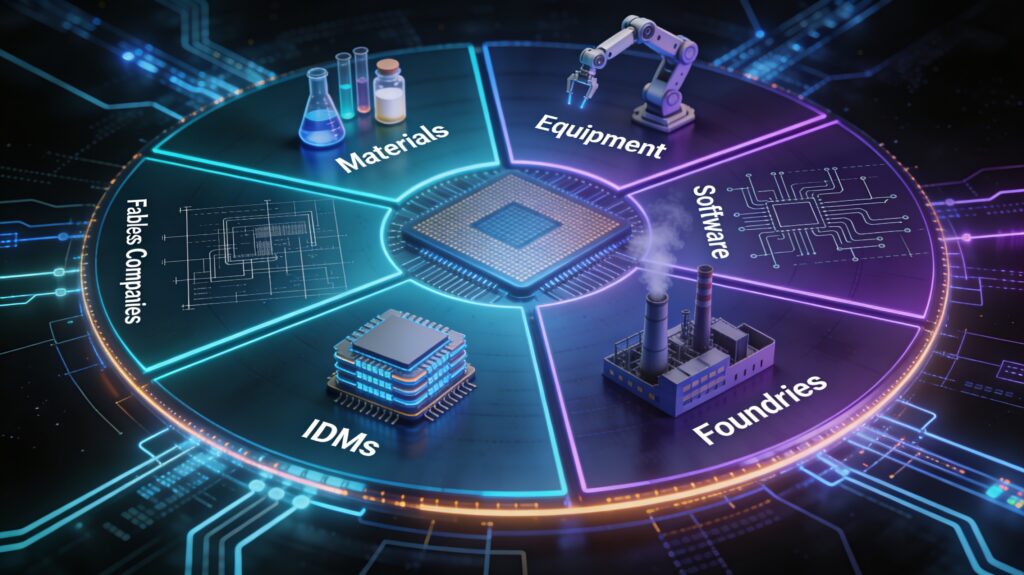
When people search for the largest semiconductor companies, they often find a confusing mix of chip designers, foundries, equipment makers, software vendors, and materials suppliers all grouped together as if they do the same job. In reality, the semiconductor industry is a full value chain, and understanding where each company sits is the key to understanding how the sector really works.
This page is designed to make that structure clear. Instead of treating the industry as one flat list, it separates the major companies into the roles they actually play: semiconductor materials, equipment manufacturers, software companies, integrated device manufacturers (IDMs), foundries, and fabless or IP-led businesses. That distinction matters because a company that makes lithography tools is fundamentally different from one that fabricates wafers, and both are different again from a company that designs chips but outsources manufacturing.
If you are researching the largest semiconductor companies for investing, market mapping, sales prospecting, or general industry learning, this layout should give you a much cleaner picture. It also helps explain why some famous names are often placed in the wrong category. A company can be large and strategically important without fitting the label people casually give it. That is where most industry summaries go wrong.
Semiconductor Industry Overview
1. Semiconductor Materials
- Kodak – Advanced materials and legacy photoresist expertise
https://www.kodak.com/en/advanced-materials/home/ - AZ Electronic Materials – Photoresists and specialty chemicals
https://www.merckgroup.com/en/company/merck-kgaa-darmstadt-germany/our-heritage/az-electronic-materials.html - Wacker Chemie – Polysilicon and silicon wafers
https://www.wacker.com/ - Sumitomo Metal Mining – High-purity metals and semiconductor materials
https://www.smm.co.jp/en/ - GlobalWafers – Silicon wafers
https://www.globalwafers.com/ - Linde – Electronic and specialty gases
https://www.linde.com/ - Air Products – Electronic gases and chemicals
https://www.airproducts.com/ - Praxair – Industrial and specialty gases (now part of Linde)
https://www.linde.com/about-linde/praxair-linde-merger - Fujifilm – Photoresists and CMP materials
https://www.fujifilm.com/products/semiconductor_materials - JSR – Photoresists and advanced materials
https://www.jsrmicro.com/ - DuPont – Electronic materials and chemicals
https://www.dupont.com/electronic-materials.html
2. Semiconductor Equipment Manufacturers
- ASML – Lithography equipment
https://www.asml.com/ - Applied Materials – Deposition, etch, CMP, and other process tools
https://www.appliedmaterials.com/ - Lam Research – Etch and deposition equipment
https://www.lamresearch.com/ - KLA – Process control and inspection equipment
https://www.kla.com/ - Tokyo Electron Limited (TEL) – Etch, deposition, and coater/developers
https://www.tel.com/ - Screen Holdings – Cleaning and lithography-related equipment
https://www.screen.co.jp/eng/ - ASM International – ALD and epitaxy equipment
https://www.asm.com/ - HANMI Semiconductor – Back-end packaging and assembly equipment
https://www.hanmisemi.com/
3. Semiconductor Software Companies (EDA & Simulation)
- Cadence – EDA tools
https://www.cadence.com/ - Synopsys – EDA tools and semiconductor IP
https://www.synopsys.com/ - Siemens EDA – EDA tools (Mentor Graphics)
https://eda.sw.siemens.com/ - Mentor Graphics – Legacy EDA brand (now Siemens EDA)
https://eda.sw.siemens.com/en-US/mentor/ - ANSYS – Multiphysics and semiconductor simulation
https://www.ansys.com/
4. Integrated Device Manufacturers (IDMs)
- Samsung – Memory and logic as IDM
https://semiconductor.samsung.com/ - SK Hynix – DRAM, HBM, and NAND
https://www.skhynix.com/ - Intel – CPUs, SoCs, and foundry services
https://www.intel.com/ - Texas Instruments – Analog and embedded processing
https://www.ti.com/ - STMicroelectronics – MCUs, sensors, and power
https://www.st.com/ - Infineon – Power and automotive semiconductors
https://www.infineon.com/ - Toshiba – Power devices and other semiconductors
https://www.global.toshiba/en/products-solutions/semiconductor.html - onsemi (ON Semiconductor) – Power and sensing
https://www.onsemi.com/ - Rohm Semiconductor – Power management and discretes
https://www.rohm.com/ - Diodes Incorporated – Discretes and analog ICs (fab-light/IDM)
https://www.diodes.com/ - Vishay – Discrete semiconductors and passives
https://www.vishay.com/ - Analog Devices – Analog/mixed-signal IDM (includes Maxim Integrated)
https://www.analog.com/
5. Foundries
- TSMC – Pure-play foundry
https://www.tsmc.com/ - GlobalFoundries – Pure-play foundry
https://www.globalfoundries.com/ - Samsung Foundry – Foundry business of Samsung
https://semiconductor.samsung.com/foundry/ - DB HiTek – Specialty foundry
https://www.dbhitek.com/
6. Fabless / Fab-light / IP Companies
- NVIDIA – GPUs and AI accelerators (fabless)
https://www.nvidia.com/ - AMD – CPUs and GPUs (fabless)
https://www.amd.com/ - Qualcomm – Mobile SoCs and modems (fabless)
https://www.qualcomm.com/ - ARM – CPU/GPU IP licensing
https://www.arm.com/ - Broadcom – Networking and connectivity (fabless/fab-light)
https://www.broadcom.com/
Conclusion
The biggest takeaway from this industry map is that the largest semiconductor companies are not all doing the same thing. Some create the raw materials that make wafer production possible, some build the machines that power advanced fabs, some provide the software used to design chips, some manufacture their own devices, and others focus entirely on design while outsourcing production. Once those categories are separated properly, the industry becomes much easier to understand.
This also explains why lists of major semiconductor companies are so often misleading. A foundry is not the same as an IDM, an EDA company is not the same as a chipmaker, and an equipment supplier can be one of the most important businesses in the sector without producing a single chip itself. If you understand those distinctions, you can read the market more clearly, compare companies more accurately, and spot where value is really created across the semiconductor supply chain. The names are familiar, but the structure behind them is what most people miss.