
Because of modern life, many systems have forgotten foundational freedoms that formed key parts of how and why the service works. Mainly because of target-driven agents using excuses to meet goals and profit erosion. If we lose the freedoms, it cuts people who needed them off, or breaks things.
The problem is, things have changed so much because of the internet that, to most people alive today, it’s so starkly different from the originals that the one-in-a-million situations begin to get ignored — when the original standards were quality-driven and thorough. The internet and app culture has changed things.
That’s not a rant. It’s a systems diagnosis. And it’s the voice of someone who is enabled, but sometimes challenged: technically capable, socially mismatched, and repeatedly told that the way they experience the world is “edge case” enough to be designed out.
The baseline we didn’t know we had
Once upon a time — not that long ago — systems came with small, quiet guarantees baked in. Not as marketing. Not as “premium features”. Just as part of how things worked.
- A line in contracts like: “Refunds will be provided if you are not satisfied with the quality.”
That’s it. No hoops. No tickets. No “we value your feedback” survey. If it was broken, you got your money back. If you didn’t like something you took it to the shopkeeper and they decided if it was fair right then and there. - Software you paid for worked offline. No accounts. No subscriptions. No “checking license server”. You installed it, you used it, you owned it.
- Tools had escape hatches: advanced options, config files, flags for unusual hardware, niche codecs, accessibility needs that didn’t match the median user.
- “Professional grade” meant it would still work when you pushed it slightly outside the happy path.
These weren’t luxuries. They were the baseline. They made room for the one-in-a-million situations that, in aggregate, are someone’s daily life.
Now? Those freedoms are quietly removed. Contracts get longer and more one-sided. Features move behind enterprise tiers. Offline modes become “legacy” or paywalled. Support scripts assume you can express your problem in exactly the right corporate language, or you’re just another difficult customer.
The system hasn’t become more efficient. It’s become more brittle — and less human.
Target-driven incentives vs. quality-driven standards
This isn’t an accident. It’s the logical outcome of target-driven corporate incentives meeting internet-scale distribution.
Agents on the front line — support staff, community managers, even well-meaning engineers — are measured on:
- Average handle time
- First-contact resolution
- Upsell rates
- Compliance with scripts and policies
None of those metrics have a slot for some things without the agent being penalised:
“This person is quoting a right I’ve never heard of, and if I don’t resolve it, they literally lose access to something they need.”
So the interaction becomes a game of deflection:
“I’m sorry, that’s not how the system works.”
“That option isn’t available anymore.”
“You’d need to upgrade for that functionality.”
The agent isn’t evil. They’re under pressure. If they don’t meet their targets, they don’t eat. But the cumulative effect is a culture where:
- Rights are treated as “policy exceptions”
- Edge cases are treated as noise
- Fairness is treated as optional
And the one-in-a-million situations — the very ones that quality-driven standards were designed to protect — are the first to be pruned.
The human cost: dehumanisation by design
When systems stop making room for edge cases, they don’t just break workflows. They break people’s sense of belonging.
You start to see phrases like:
- “That’s just how it is now.”
- “Everyone else manages fine.”
- “It’s not worth building for that.”
Each one is a small act of dehumanisation. They teach us to accept “bad for them” and move on. To treat misfortune as normal. To stop asking whether a process is fair, and start asking whether it’s scalable.
This is especially sharp for people who don’t fit the average. For someone with autism, atypical language traits, or a technical mental model that doesn’t match the predefined boxes, every interaction becomes a test of whether they can perform “normal” well enough to be heard.
Imagine trying to assert a right you read about online, only to be met with:
“I’ve never heard of that.”
“That doesn’t exist.”
“You must be mistaken.”
And you know — with technical certainty — that the right does exist, or at least it did. But the person on the other side has never been trained on it. Their system doesn’t expose it. Their targets don’t reward it. So from their perspective, you’re just another idiot making things up.
That’s not a communication problem. That’s a design problem. It’s what happens when systems are optimised for the median user and the one-in-a-million is treated as a cost centre.
The mismatch: technical ability vs. corporate boxes
There’s another layer: the mismatch between what’s technically possible and what the organisation will allow.
Some people — often the same ones who are “a bit too much” in support chats — have a technical intuition that doesn’t fit clean job titles or product tiers. They’ll look at a problem and say, “That should be simple. You could do X, Y, Z.” And they’re right, in a purely technical sense.
But the response is often:
“That’s ridiculous.”
“We don’t support that.”
“It’s too good to be true.”
Connections that used to be part of the standard — escape hatches, advanced options, documented edge-case workflows — are gone. Not because they were impossible, but because they weren’t “on strategy”. They didn’t fit the roadmap. They didn’t move the key metrics.
So the system becomes worse, even as the technology becomes more powerful. And the people who could have stretched it in interesting, useful ways are quietly told to sit down and use the app like everyone else.
Where hope lives: auditability, community, repair
None of this is inevitable. The same internet that enabled target-driven erosion also enables something else: visibility, coordination, and forkability.
Open source isn’t the whole answer, but it’s a critical piece. When systems are auditable:
- You can see when a right is removed.
- You can document the old behaviour.
- You can fork, patch, or maintain a version that still respects the one-in-a-million.
Offline capability, local control, and configurability aren’t nostalgia. They’re resilience. They’re the difference between a system that works when the network, the company, or the economy is under stress, and one that silently fails.
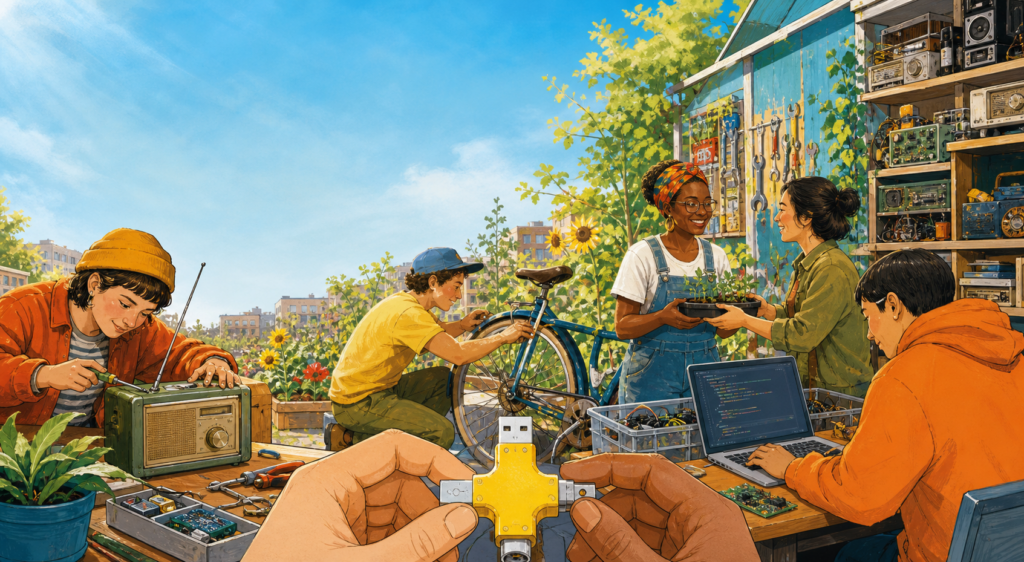
Community projects — repair labs at libraries, local grow groups, maker spaces, user-run mirrors and forks — are where the foundational freedoms get re-embedded in practice. Not as theory, but as:
- “Bring your broken thing; we’ll open it up and see what’s wrong.”
- “Here’s how to run this without an account.”
- “This config still works if you need that edge case.”
That’s where the direction changes. Not by waiting for permission, but by building alternatives that make the old fairness visible again.
A call to the one-in-a-million
If you’ve ever been in a chat, on a call, or in a shop and realised:
- The rule they’re quoting doesn’t match the rule you read.
- The feature you relied on is gone, with no explanation.
- Your perfectly reasonable technical solution is being treated as fantasy.
- You’re being asked to perform “normal” well enough to deserve basic fairness.
You’re not imagining it. You’re experiencing rights erosion in real time.
And you’re not alone. There are other people out there doing this: noticing the pattern, naming it, and building around it.
So here’s the ask:
- Comment with your own one-in-a-million story. Where did a foundational freedom disappear? What did it break for you?
- Join or start a community project: a repair lab, a grow group, a local mirror, a documentation sprint for old-but-still-valid workflows.
- Document the edge cases. When you find a right, a config, a workaround that still honours the old quality, write it down. Share it. Mirror it.
The goal is leverage. It’s making sure that when someone says, “That’s just how it is now,” there’s a visible, working counterexample that says: No. It can be this way.