
Mental Health medication could be illegal under International Law. A mounting body of legal evidence suggests that forced psychiatric medication under certain circumstances may violate international human rights law—creating a potential nightmare for UK hospitals when cases reach the courts. This analysis reveals how three key legal instruments converge to create an unexpectedly strong defence for patients, one that most mental health staff prefer to ignore.
The International Legal Foundation: CRPD’s Clear Mandate
The UN Convention on the Rights of Persons with Disabilities (CRPD) represents the most comprehensive international legal framework protecting disabled individuals’ rights. General Comment No.1, issued by the CRPD Committee, provides authoritative interpretation that mental health legislation allowing forced treatment constitutes “discriminatory substitute decision-making regimes”.
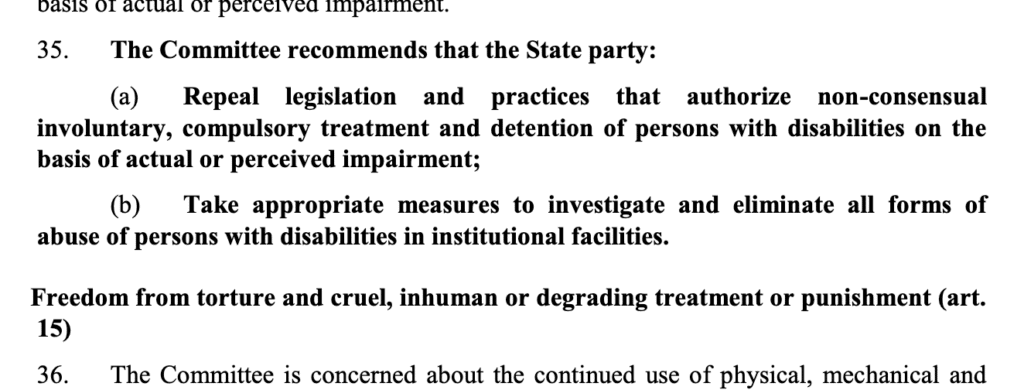
The General Comment states unequivocally that “States parties have an obligation to require all health and medical professionals (including psychiatric professionals) to obtain the free and informed consent of persons with disabilities prior to any treatment”. This creates what legal scholars term an “unequivocal endorsement of abolition”—meaning no medical treatment without genuine consent.
Article 14 of the CRPD explicitly states that “the existence of a disability shall in no case justify a deprivation of liberty”. Crucially, Article 25 clarifies this applies “at all times, including in crisis situations”. This language leaves little room for interpretation—disability-based detention is prohibited even during psychiatric emergencies.
Mental Health medication could be illegal under International Law.
The Vienna Convention: Making International Law Binding
Here’s where the legal trap becomes inescapable. The Vienna Convention on the Law of Treaties (1969), specifically Article 31(3)(b), provides that treaties must be interpreted through “any subsequent practice in the application of the treaty which establishes the agreement of the parties regarding its interpretation”.


This principle, accepted by UK courts as customary international law, means that authoritative interpretations like CRPD General Comment No.1 carry legal weight in domestic courts. As one legal analysis notes: “the rules set out in Articles 31 and 32 of the Vienna Convention have been accepted by the International Court of Justice as being an accurate statement of customary International law; and English courts have applied the rules on the basis that they represent customary International law and are therefore part of English law”.
Article 27 of the Vienna Convention further stipulates that “a party may not invoke the provisions of its internal law as justification for its failure to perform a treaty”. This creates what legal scholars call the “one true interpretation” principle—domestic courts must endeavour to ascertain the correct interpretation of treaty provisions “without taking colour from distinctive features of the legal system of any individual contracting state”.
The Equality and Human Rights Commission Connection
The Equality and Human Rights Commission document referenced explicitly describes coercion to take medications that someone believes are illegally prescribed as an extreme form of coercion. This creates a direct link between domestic human rights obligations and international law.
The Staff Resistance Reality
The most troubling aspect of this legal landscape is the institutional resistance encountered by patients attempting to assert these rights. Mental health professionals often act defensively rather than objectively when confronted with legal challenges to treatment decisions. This defensive posture prevents proper legal analysis of individual cases.
Staff training materials typically emphasise minimising legal risk rather than respecting patient rights. The focus remains on procedural compliance with the law in ways they can defend rather than substantive analysis of whether treatment can be legally justified under domestic or international human rights law. This creates a systematic barrier to patients accessing their legal protections.
Many professionals appear reluctant to engage with the international law arguments, preferring to rely on domestic statutory authority. However, as the Vienna Convention makes clear, this approach may not provide adequate legal protection when cases reach general jurisdiction courts.
The Legal Trap for Hospitals: Mental Health medication could be illegal under International Law.
This convergence of international and domestic law creates a potential litigation nightmare for NHS trusts. While hospitals currently operate under the assumption that Section 58 of the Mental Health Act 1983 provides adequate legal authority during the first 3 months of detention, international law arguments could fundamentally challenge this assumption.
The “literal and obvious meaning” of the CRPD provisions, as interpreted by the authoritative Committee, appears to prohibit exactly the type of forced medication permitted under Section 58(3)(b). When combined with the Vienna Convention’s requirement that domestic courts respect international treaty interpretations, this creates unprecedented legal vulnerability.
Courts cannot simply ignore these international obligations. The Human Rights Act 1998 already requires courts to interpret legislation compatibly with convention rights where possible. When CRPD obligations are added to this framework, the legal foundation for forced psychiatric medication becomes increasingly uncertain.
The Immediate Legal Danger
The most disturbing element is the temporal gap in legal protection. Even if forced medication ultimately proves illegal under international law, hospitals can currently medicate patients under Section 3 detainment or immediate harm provisions before legal defence can be established. This creates a window of legal vulnerability where irreversible treatment occurs despite potential illegality.
This suggests a fundamental flaw in the current legal framework—prevention of illegal treatment should occur before administration, not after lengthy court proceedings that might prevent patients defending themselves. The current domestic system effectively permits potentially illegal medication while legal challenges work through the courts according to the Cambridge Law review, but it may still be illegal according to international laws.
Recommendations for Legal Practitioners
Legal practitioners should consider immediate judicial review applications where CRPD arguments apply. The combination of international law obligations and domestic human rights protections creates stronger grounds for emergency injunctions than previously recognised.
Expert witness testimony on international law obligations should be sought in appropriate cases. Courts need proper legal analysis of how Vienna Convention interpretation principles apply to CRPD obligations in the psychiatric context.
Most importantly, practitioners should document defensive staff behaviour that prevents proper legal analysis. This institutional resistance may itself constitute a violation of procedural rights under Article 6 ECHR and the Codes of Practice like the NMC Code.
The legal landscape is shifting rapidly, and mental health institutions unprepared for this change may find themselves exposed to significant litigation risk. The question is no longer whether these challenges will succeed, but when the first major case will establish the precedent that fundamentally restructures psychiatric treatment law in the UK.
The legal foundations are already in place—it’s simply a matter of time before they’re properly tested in court. Mental Health medication could be illegal under International Law.
Check out other mental health articles like Preparing for an International Holiday in Europe with Mental Illness and Understanding Targeted Individuals: Beyond the Mental Illness Label