
You have a trading theory. Price jumps when the moon is full. The S&P 500 rallies every third Tuesday. Your mate’s cousin says tech always crashes before Christmas. You’re convinced you’ve spotted a pattern no one else can see. You need a financial backtester.
So you dump £5,000 into a trade based on this hypothesis, watch it collapse in 47 minutes, and learn the hard way: your pattern was just noise. Market noise.
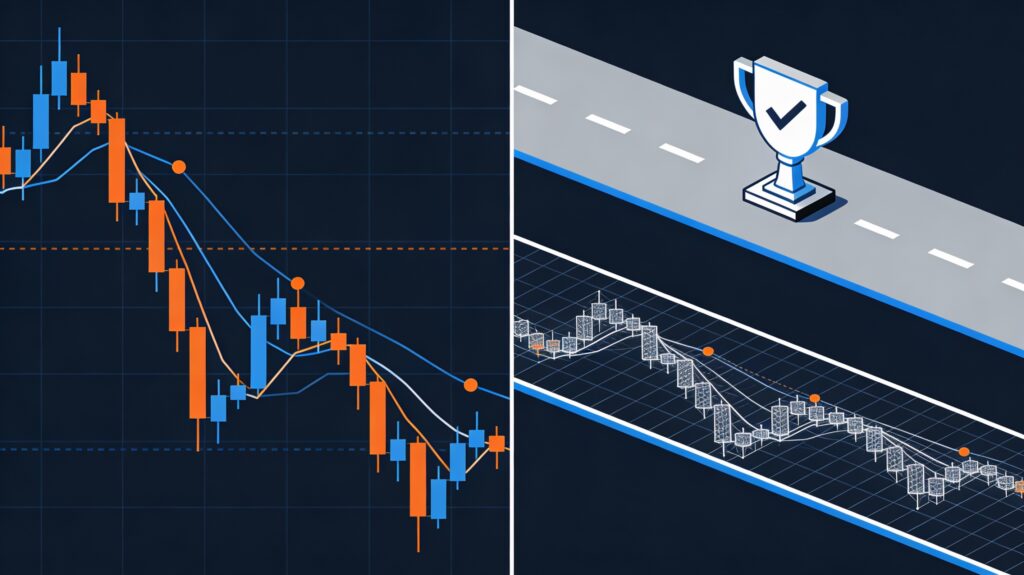
There is a better way. It’s called backtesting—running your “brilliant” trading strategy against historical data to see if it would have made money or melted your account. It’s the difference between believing you have an edge and proving you do.
Enter SupremeBacktester: a deliberately minimal Python backtester powered by yfinance and brutal honesty.
What Is Backtesting? (The Honest Version)
Backtesting is simulation. You feed historical market data into your trading strategy, let it “trade” on paper, and watch the results unfold. It answers one question: would this strategy have worked in the past?
This is not—repeat, not—a guarantee it will work in the future. Markets change. Patterns don’t persist. Overfitting is real. But backtesting is still better than the alternative: throwing money at untested ideas and hoping.
- Upside: You test 1,000 trades in 10 seconds instead of losing £5k.
- Downside: Past performance is not indicative of future results (this disclaimer exists for a reason).
- Reality: It’s the only game in town if you want to avoid being a pure gambler.
Why SupremeBacktester is Good Financial Backtester?
There are dozens of backtesting frameworks. QuantConnect, Backtrader, Backtesting.py. They’re often powerful, complex, and have a learning curve steeper than the markets themselves.
SupremeBacktester does something radical: it stays small. It uses yfinance (free Yahoo Finance data), keeps the code readable, and gives you example trading logic you can actually modify without a PhD in quantitative finance.
It’s not “supreme” because it’s the best. It’s “supreme” because it gets out of your way. You write the strategy logic, it runs the backtest, you get the results. Done.
How It Works (Simplified)
- Define your strategy: “Buy when price crosses above the 50-day moving average, sell when it crosses below.”
- Feed it historical data: TSLA daily prices for the last 5 years, via yfinance.
- Let it simulate: The backtester applies your rules to each day, tracking entries, exits, wins, losses.
- Analyze the results: Total return, win rate, maximum drawdown, Sharpe ratio—all the metrics that tell you if this strategy was real or just luck.
The key insight: you can’t change the past. If your strategy would have failed on historical data, it probably will fail on new data too. That’s not fatalism—that’s data.
The Catch (And There’s Always a Catch)
Overfitting is the silent killer. If you test 100 random strategies on the same dataset, one of them will look brilliant purely by accident. You’ll optimize on the exact rules that worked last time, and then—when you deploy it live—the market laughs at you.
Other gotchas:
- Survivorship bias: Yahoo Finance only has data for stocks that still exist. Dead companies are invisible.
- Look-ahead bias: If your strategy “knows” tomorrow’s close, you’ve cheated without realizing it.
- Slippage and fees: Real trading involves friction. Backtests often ignore it.
- Correlation collapse: Patterns that worked for 20 years can break overnight if market conditions shift.
SupremeBacktester is intentionally basic because it forces you to think about these problems. No framework magic to hide mistakes.
Getting Started With This Financial Backtester
Clone the repo:
git clone https://github.com/HomingHamster/SupremeBacktester.git
cd SupremeBacktester
pip install -r requirements.txt  # yfinance, pandas, numpy
python main.py
main.py contains an example strategy—probably something like a moving average crossover. Read it. Modify it. Test your theory instead.
The workflow:
- Write your trading logic in the strategy function (entry/exit rules)
- Specify a stock ticker and date range
- Run the backtest
- Read the output: returns, win rate, drawdown, performance stats
- If it looks good, ask yourself: “Why would this work that actually worked in the future?” (Often, the answer is: it wouldn’t.)
What You’ll Learn (The Hard Way)
Run enough backtests and you’ll notice:
- Simple beats complex. Your 47-line moving average strategy will beat your 300-line neural net about half the time.
- Luck is real. Some trades make money. Some lose. Randomness is part of the game.
- Consistency is rare. A strategy that works on Apple might flop on Tesla. Market structure varies.
- Fees matter. Even 0.1% per trade stacks up. Your 45% annual return becomes 15% after commissions. (This backtester does not model fees, at the moment.)
- Drawdowns hurt more than gains feel good. A 50% loss needs a 100% gain to recover. Your psychology will break first.
All of this is learnable by running backtests instead of trading real money.
Why This Matters (Beyond Trading)
Backtesting teaches a skill that transfers everywhere: test your assumptions before committing resources.
Marketing campaign hypothesis? A/B test it. Product feature idea? MVP first. Business strategy? Model it, run scenarios, measure the downside before launch.
The markets just force this discipline harder and faster. Your backtest doesn’t lie about returns. It doesn’t rationalize failure. It shows you numbers.
The Reality Check
SupremeBacktester is not going to make you rich. Neither is backtesting. Professional quants with PhDs and supercomputers still lose to index funds 80% of the time.
What backtesting does do: it saves you money by sorting real ideas from magical thinking before you risk capital. And that edge—thinking before acting—compounds over time.
Remember: be rigorous. Test long periods. Test multiple assets. Assume fees and slippage. Split your data: train on one period, validate on another. If the strategy dies on out-of-sample data, it wasn’t real.
The repository is here: github.com/HomingHamster/SupremeBacktester. Clone it. Break it. Learn from it. Financial backtester with it. And for the love of sustainable markets, never trade real money on strategies you haven’t backtested first.